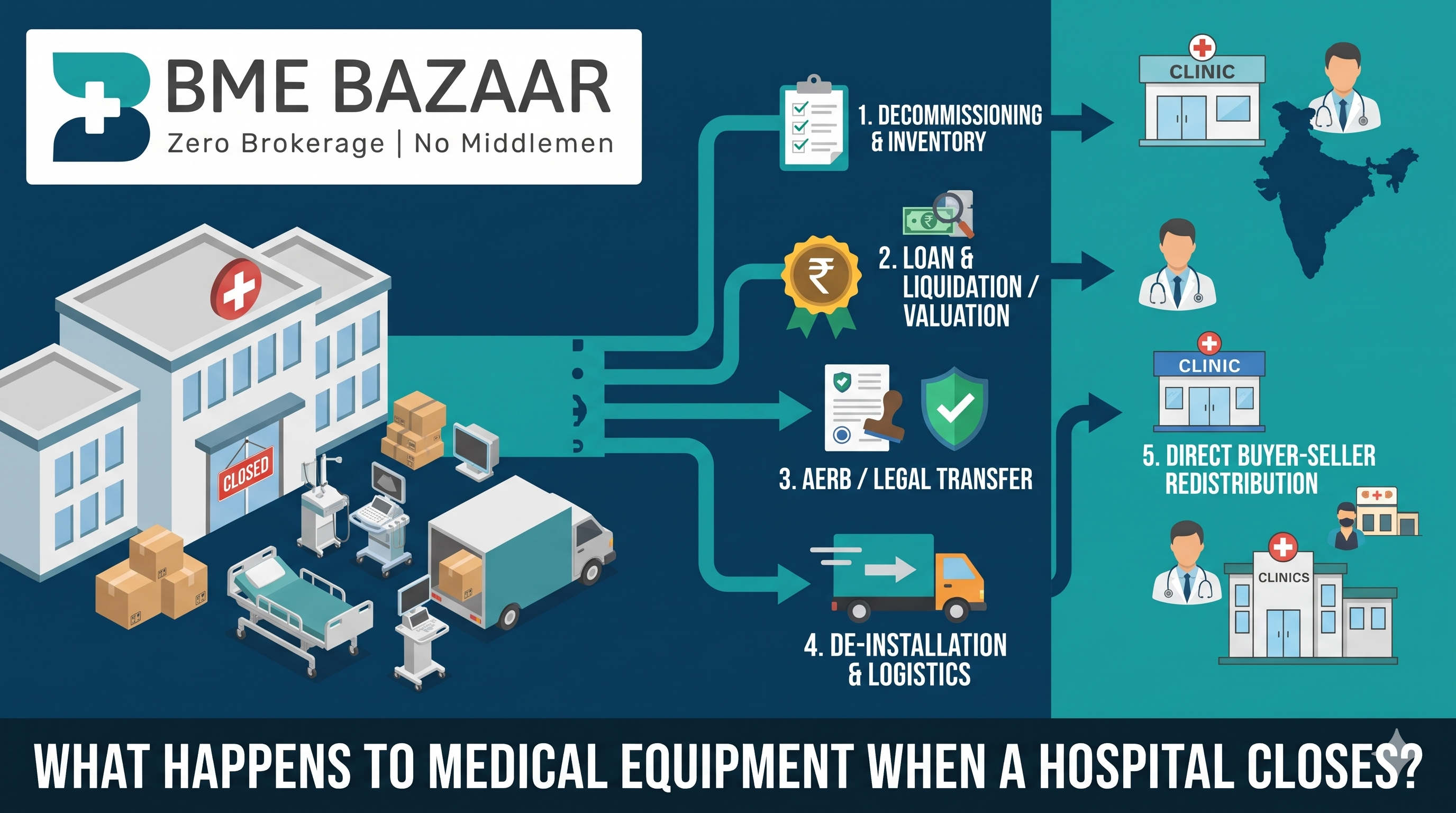
What Happens to Medical Equipment When a Hospital Closes?
Whether due to financial restructuring, corporate mergers, or promoters retiring, hospital closures are an unfortunate reality within India's healthcare sector. But when a 50-bed, 100-bed, or even larger hospital closes its doors, it leaves behind a massive volume of highly valuable, life-saving assets.
What happens to the CT scanners, OT tables, ventilators, and ICU beds?
For doctors, investors, and hospital owners looking to expand or upgrade, hospital closures present an invaluable opportunity to acquire high-grade, fully functional medical equipment at a fraction of its original price.
Here is a practical look at what happens to medical assets when an Indian hospital shuts down, how the liquidation process works, and how you can safely acquire these decommissioned units.
🔍 THE HOSPITAL CLOSURE ASSET FLOW:
1. Decommissioning & Inventory              4. De-installation & Logistics
2. Asset Liquidation & Appraisal             5. Direct Buyer–Seller Redistribution
3. Regulatory (AERB) & Legal Transfers
👉 Looking to acquire decommissioned assets directly? Avoid the broker markups: Browse verified used & refurbished medical equipment listings here or Post your requirements on BMEBazaar.
1. Decommissioning & Inventory
The first step in any hospital closure is cataloging and assessing the condition of every single medical asset.
Asset Verification: Biomedical and administration teams tag and inspect every piece of equipment—from high-value imaging machines (MRI, CT, X-Ray) to everyday ward furniture and ICU monitors.
Operational Classification: Items are categorized based on their working status: "Active & Functional," "Requires Repair," or "Scrap/Obsolete."
Documentation Gathering: Original purchase invoices, service logs, warranty documents, and compliance records are gathered to prove the legal ownership and maintenance history of the machines.
2. Asset Valuation & Liquidation Options
Once the assets are cataloged, the closing hospital works to recover as much capital as possible through various liquidation routes.
Internal Transfers: If the closing hospital is part of a larger healthcare chain, high-value, versatile equipment is often transferred to sister branches that require upgrades.
Lender & Creditor Seizures: In cases of insolvency, bank creditors may step in to auction off the assets to recover outstanding debts.
Bulk Liquidation & Direct Sales: To avoid high holding costs, many facilities opt to sell off their entire asset inventory quickly to second-hand dealers, refurbishers, or other medical practices.
3. Regulatory and Legal Transfers (Crucial Checklist)
In India, you cannot simply load a piece of radiation-emitting or high-risk medical hardware into a truck and use it elsewhere without legal oversight.
AERB e-LORA Licensing: For X-Ray machines, C-Arms, and CT scanners, the closing hospital must initiate a decommissioning request on the Atomic Energy Regulatory Board's e-LORA portal. This formally de-registers the equipment from their license, allowing the buyer to apply for re-registration and a license to operate.
Compliance Checks: Check that the devices being sold are registered under the CDSCO (Central Drugs Standard Control Organization) and possess the necessary clearance certificates.
Software License Transfers: For computerized systems, ensure that software and service licenses are transferable to the new buyer to prevent features from becoming deactivated post-sale.
4. De-installation & Specialized Logistics
Medical hardware is highly sensitive to environmental factors, vibrations, and improper handling during transit.
Stage | Critical Inspection | Action Items |
Rigging & Removal | Specialized dismantling of large systems. | Hire experienced biomedical riggers to safely remove heavy units without damaging internal alignments. |
Protective Packaging | Securing sensitive electronics and optical arrays. | Use shock-absorbent materials, anti-static wraps, and customized wooden crates. |
Transit Insurance & Tracking | Safe overland transport. | Ensure you are covered by comprehensive transit insurance and use climate-controlled transport where needed. |
5. Re-Commissioning & Redistribution
After the equipment arrives at its new home, it undergoes rigorous inspection and setup before going back into service.
Thorough Biomedical Checkups: Re-commissioned machines require detailed calibration, preventive maintenance, and a full battery/part review by a certified biomedical engineer.
Verification & Testing: Once installed, the new owner must have an approved agency perform safety checks (e.g., radiation leakage tests for X-Rays) to obtain their own operating licenses.
Re-registration: Register the relocated equipment under the new hospital's licenses on the e-LORA portal or other health boards before treating the first patient.
Find High-Value Closed Hospital Assets on BMEBazaar
Acquiring equipment from a closing hospital is a smart way to maximize your setup budget. By using BMEBazaar, you can skip brokers, access verified equipment, and verify its history directly with the sellers.
Browse Decommissioned Hospital Equipment — See live listings of pre-owned OT, ICU, diagnostic, and ward assets directly from across India.
Post Your Entire Procurement Requirement — Equipping a new hospital or expanding a clinic? Post a free requirement on BMEBazaar and connect with liquidators, sellers, and diagnostic practices directly.