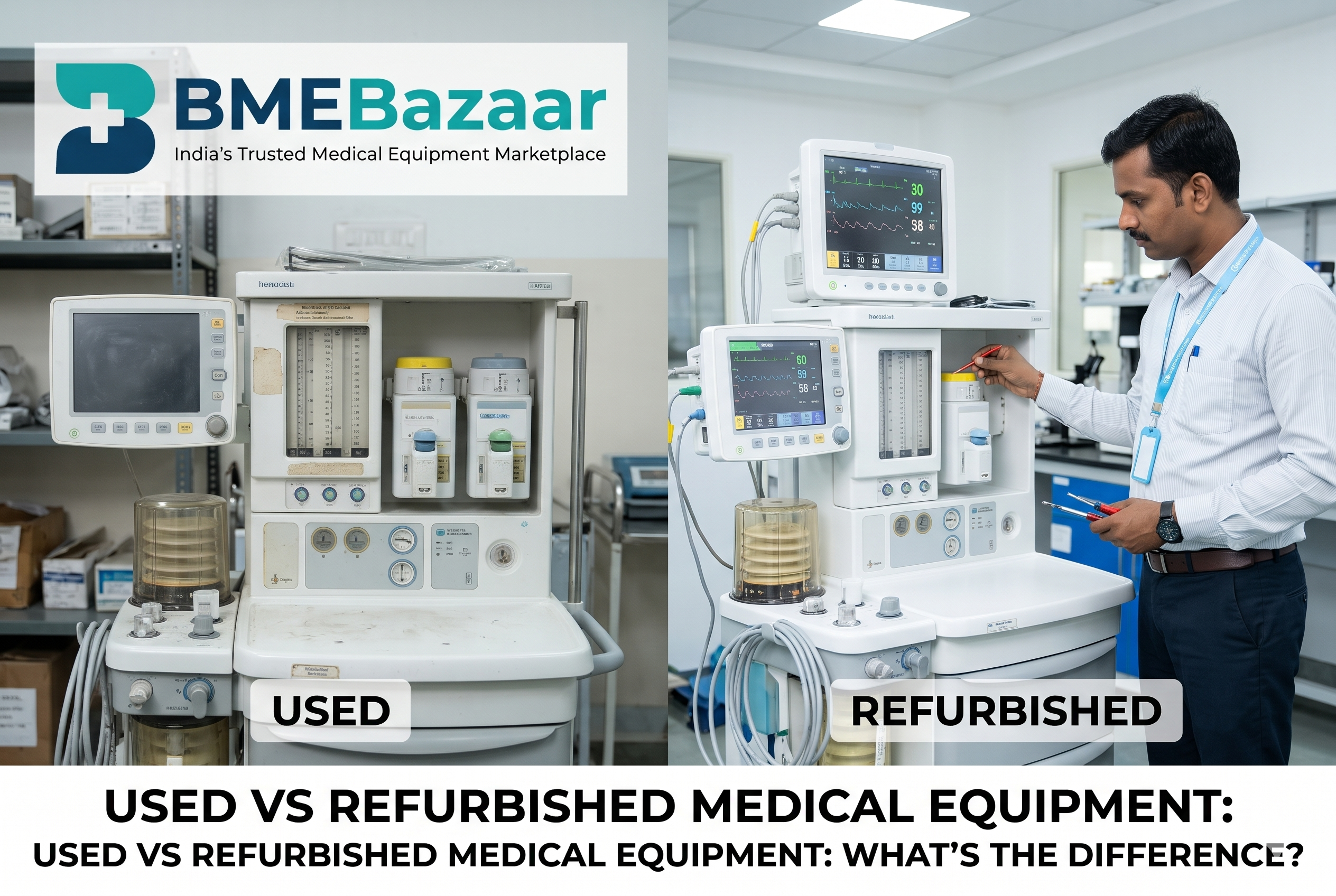
Used vs. Refurbished Medical Equipment: What's the Difference?
When expanding a healthcare facility, setting up a new clinic, or upgrading diagnostic capabilities in India, managing capital expenditure is a top priority. Acquiring pre-owned medical equipment is a highly effective way to reduce costs, but buyers often face confusing terminology.
The terms "Used" and "Refurbished" are frequently used interchangeably, yet they represent entirely different levels of quality, reliability, and investment risk.
This straightforward guide breaks down the critical differences to help Indian doctors, hospital owners, and healthcare investors make informed, cost-effective decisions.
The Core Difference at a Glance
In simple terms, "Used" refers to the equipment's history, while "Refurbished" refers to its condition.
Feature | Used Medical Equipment (As-Is) | Refurbished Medical Equipment |
What is it? | Equipment sold in its current state, straight from the previous owner. | Equipment restored to original OEM safety and functional standards. |
Inspection & Testing | Minimal or none (usually just a basic power-on check by the seller). | Deep technical inspection, worn-out parts replaced, software updated. |
Calibration | As-is (may need recalibration). | Recalibrated and certified to meet clinical accuracy. |
Cosmetics | Signs of wear, scratches, or fading. | Cleaned, repainted, and cosmetically restored. |
Warranty | Rarely offered (typically sold "as-is" with no guarantee). | Often comes with a 3-month to 1-year warranty or AMC options. |
Price Point | Lowest cost (up to 70% off new price). | Mid-range cost (30% to 50% off new price). |
1. Used (As-Is) Medical Equipment: High Risk, Lowest Cost
Used equipment is typically decommissioned from an active hospital or clinic and sold directly without any modifications.
Best suited for:
Non-critical, mechanical, or non-complex equipment (e.g., hospital beds, manual wheelchairs, stainless steel OT tables).
Buyers with access to trusted in-house biomedical engineers who can inspect, service, and calibrate the machine before clinical use.
The Risks:
Hidden Wear: Hidden internal component degradation.
No Safety Net: If the device fails a week after purchase, the buyer covers the repair costs entirely.
Missing Accessories: Often missing essential cables, probes, or manuals that are expensive to source separately.
2. Refurbished Medical Equipment: Restored & Certified
Refurbishing is a rigorous, multi-step process typically carried out by certified biomedical engineers or specialized third-party refurbishers to bring the equipment back to "like-new" performance.
   [ Used Machine ] ──> [ Complete Dismantling & Deep Cleaning ]
                                       │
                                       ▼
   [ Calibration & Certifications ] <── [ Component Testing & Parts Replacement ]
The Refurbishing Process Includes:
Decontamination & Cleaning: Deep sanitization and cosmetic restoration.
Technical Diagnosis: Complete dismantling to inspect internal circuits, vacuum systems, or mechanics.
Parts Replacement: Worn-out, high-use components (like batteries, seals, buttons, or display screens) are replaced with new ones.
Software & Calibration: Re-installing or updating system software and calibrating output (e.g., radiation output on an X-Ray or energy delivery on a defibrillator) to match factory standards.
Quality Assurance Testing: Stress-testing the equipment to ensure it is safe for patient care.
Best suited for:
Complex diagnostic, imaging, and life-support devices (e.g., Ultrasound machines, C-Arms, CT Scanners, ICU Ventilators, Patient Monitors).
Facilities that need immediate clinical deployment with minimal downtime risk.
Which is Right for Your Facility?
To make the best financial and operational choice, ask yourself these three questions:
How critical is the equipment to patient life and safety? For life-support (ventilators) or high-precision diagnostic imaging (CT, Ultrasound), refurbished is highly recommended. For patient ward furniture, used is often perfectly fine.
Do you have a reliable biomedical engineer? If yes, you can confidently buy "used" assets and handle the servicing and calibration yourself. If not, go with "refurbished" to secure a warranty and third-party support.
What is the availability of spare parts? Ensure that the specific make and model—whether used or refurbished—is still supported with replacement parts in India.
Avoid Brokerage Markups When Buying Either
No matter which route you choose, third-party brokers can inflate second-hand medical equipment prices by 15% to 30% in India. Connecting directly with the seller ensures transparent service histories and better bargaining power.
Source Wisely on BMEBazaar:
Browse Available Medical Equipment — Explore direct, zero-brokerage listings for used and refurbished medical gear from doctors and trusted vendors across India.
Post Your Equipment Requirements — Looking for a specific refurbished model or budget-friendly used unit? Post a "Wanted" request on BMEBazaar so sellers can reach you directly with matching offers.