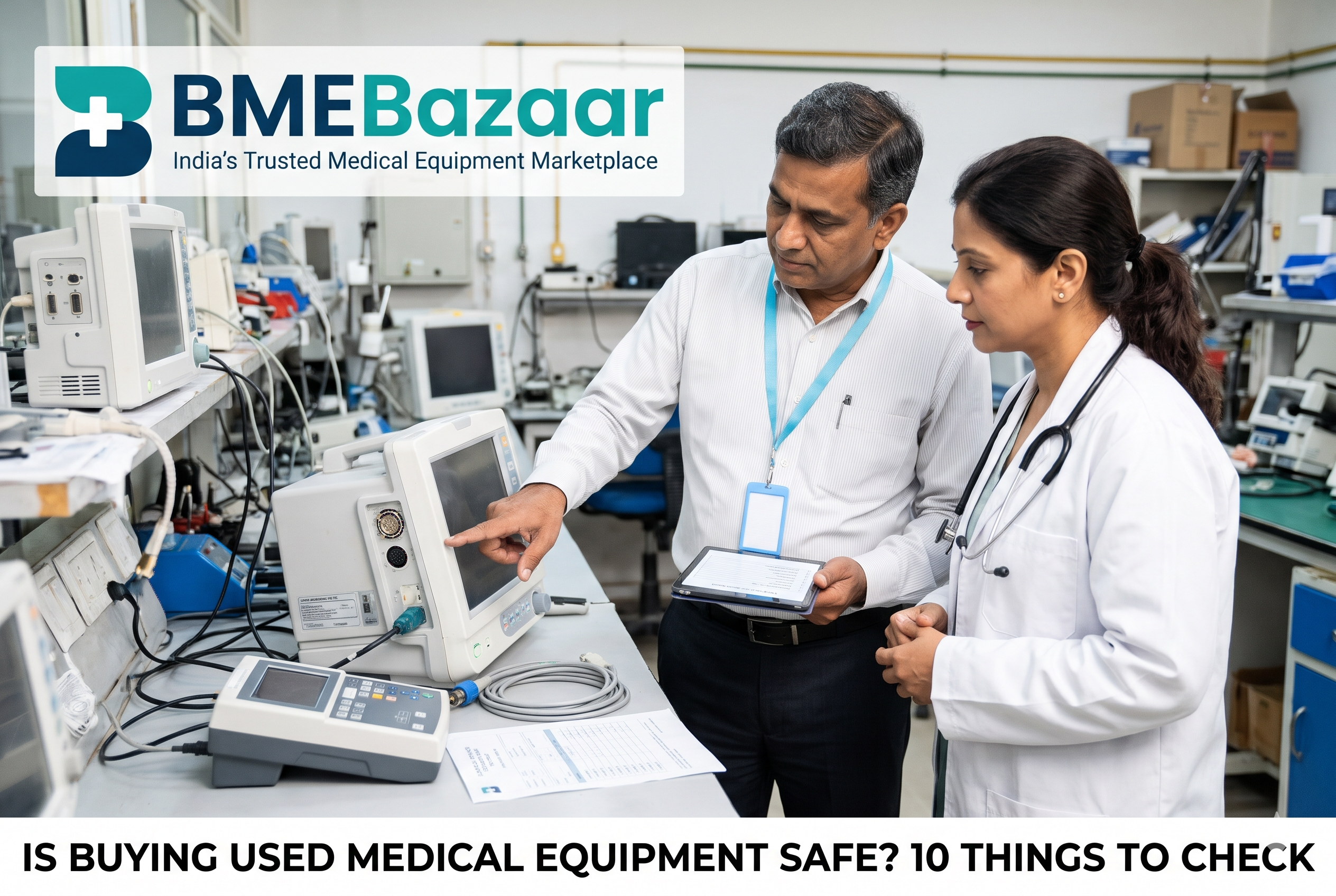
Is Buying Used Medical Equipment Safe? 10 Things to Check
For India’s doctors, clinic owners, and hospital administrators, buying used medical equipment is a financially smart way to scale up without the crushing burden of high capital expenditure. When done correctly, sourcing pre-owned devices can save you 30% to 70% of the cost of new equipment.
But is it safe?
The short answer is yes, but only if you take a rigorous approach to vetting and testing. In healthcare, equipment failure isn’t just an operational inconvenience—it directly impacts patient safety and clinical outcomes.
To make sure your next pre-owned purchase is safe, reliable, and compliant, use this practical 10-point inspection checklist before you sign on the dotted line.
The 10-Point Buyer Safety Checklist
                      [ SAFE PRE-OWNED BUYING PROCESS ]
 ┌───────────────────────────┼───────────────────────────┐
 ▼                           ▼                           ▼
[ THE SYSTEM ]              [ THE HISTORY ]             [ THE SUPPORT ]
 1. Physical Inspect         4. Original Service Logs    8. AERB / CDSCO
 2. Live Demostration        5. OEM vs. Third-Party      9. Warrenty / AMC
 3. Software Licencing       6. Age & Obsolescence      10. Logistics
                             7. Spare Part Access
1. Physical & Structural Integrity
Examine the machine’s exterior for signs of impact, rust, or fluid ingress. Check all cables, ports, and joints. Fragile parts (like transducer casings on ultrasound probes or glass assemblies) should be scrutinized for hairline fractures.
2. Live Operational Demonstration
Never purchase a medical device blind or solely based on photos. Ask for a live demonstration—either in person or via video call. Watch the device go through its complete boot sequence to ensure it doesn't flag software errors or calibration failures.
3. Software Licensing & Transferability
Modern medical devices rely heavily on software. Confirm if the operating system and key software features require a license transfer fee from the original manufacturer (OEM). Some proprietary firmware gets locked or deactivated when a system is registered to a new owner.
4. Service Logs & Maintenance Records
A safe machine is a well-maintained one. Demand to see the equipment’s service history. Ask for records of past repairs, component replacements, and routine preventive maintenance (PM) to ensure it wasn't neglected.
5. OEM vs. Third-Party Parts
Ask if previous repairs were completed using Original Equipment Manufacturer (OEM) parts or third-party substitutes. While third-party components are cheaper, some critical assemblies (like imaging tubes or internal patient-monitoring sensors) require OEM parts to guarantee accuracy.
6. Age and End-of-Life (EOL) Status
Ask for the manufacturing date and check if the device has been declared "End-of-Life" (EOL) or "End-of-Support" (EOS) by the OEM. If a model is too old, finding technicians who know how to service it becomes difficult.
7. Future Spare Parts Availability
Before buying, check with local biomedical distributors or engineering networks to confirm if spare parts (e.g., batteries, filters, transducers) are actively stocked in India for that specific make and model. A cheap machine is a waste of money if a single blown fuse makes it permanently unusable.
8. Regulatory Approvals (AERB & CDSCO)
Ensure the unit complies with Indian healthcare regulations:
Imaging/Radiology Equipment: Must have Atomic Energy Regulatory Board (AERB) approval and go through decommissioning & re-registration on e-LORA.
General Medical Devices: Ensure the model is certified and complies with the Central Drugs Standard Control Organization (CDSCO) guidelines.
9. Warranty & After-Sales Support
Unlike buying "as-is" in an unverified market, aim to secure a safety cushion. Try to negotiate at least a 30- to 90-day testing warranty. Additionally, ask the seller or a reliable third party if they can offer an Annual Maintenance Contract (AMC).
10. De-installation, Logistics & Re-installation
Medical equipment is incredibly sensitive to transit vibration and temperature. Confirm who handles, packs, and transports the equipment. Improper de-installation and transport can render a perfectly safe machine completely useless by the time it reaches your clinic.
Inspecting Made Easy: Source Directly Without the Risk
Navigating these steps is easier when you buy directly from trusted hospitals, medical practices, or verified biomedical dealers, cutting out middleman guesswork and excessive broker markups.
Protect Your Investment on BMEBazaar
Browse Verified Used Equipment Listings – Explore medical gear listings directly from sellers, complete with photos, seller details, and history.
Post Your Equipment Requirements – Can’t find what you need? Post a "Wanted" request on BMEBazaar so sellers with checked, certified devices can contact you directly.