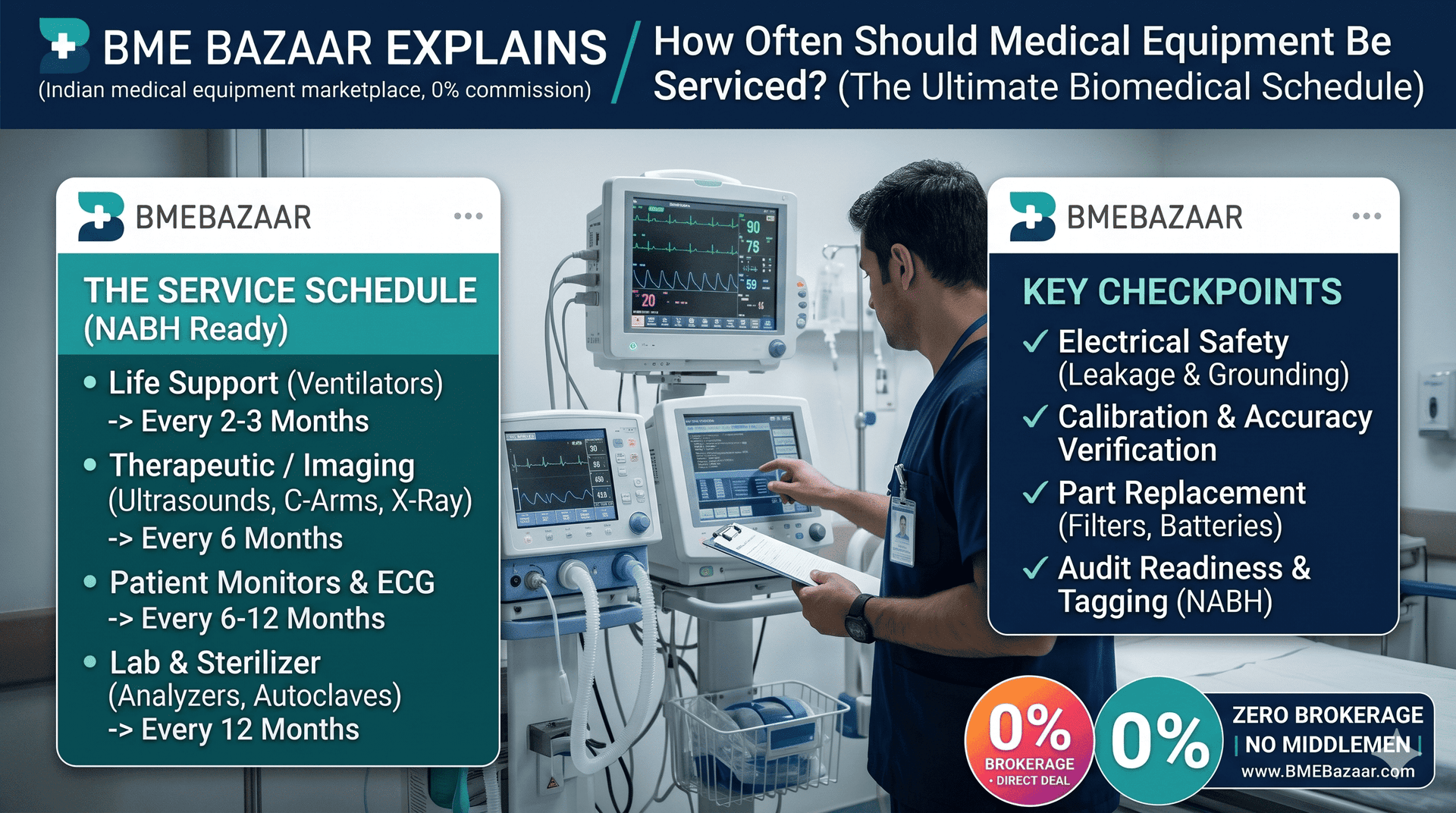
How Often Should Medical Equipment Be Serviced? (The Ultimate Biomedical Schedule)
In any healthcare facility, medical equipment is the lifeline of clinical operations. When a critical machine goes offline, it doesn't just halt diagnostic and treatment capabilities; it directly compromises patient safety and heavily impacts the hospital's financial bottom line.
One of BMEBazaar’s most frequently asked questions from clinic owners and hospital administrators is simple: How often should medical equipment be serviced?
There is no one-size-fits-all answer. Servicing and calibration frequencies are determined by a complex mix of clinical risk, manufacturer (OEM) mandates, the age of the equipment, and regulatory standards set by bodies like NABH and AERB.
In this exhaustive guide, we breakdown the required maintenance intervals, establish an inspection schedule, and show you how to maintain compliance while keeping operational costs low.
The 4-Tiered Healthcare Maintenance Calendar
A resilient medical equipment maintenance program is divided across four distinct time horizons, sharing responsibilities between everyday clinical users and specialized biomedical engineering teams:
Tier 1 (Daily/Per-Shift Checks by Nurses & Operators): High-frequency visual inspections (such as check the readiness indicators on defibrillators, clean intake filters, and check backup batteries) to prevent immediate failures.
Tier 2 (Monthly/Quarterly Checks by In-House or On-Call Biomeds): Scheduled preventive maintenance (PM) for wear-and-tear items (like valve leak tests, turbine filter replacements, O2 sensor calibration, and pressure testing).
Tier 3 (Semi-Annual/Annual Inspections by AMC/CMC Service Providers): Deep functional testing, safety testing (such as grounding, electrical leakage current, and insulation), and high-accuracy calibration.
Tier 4 (Annual Safety & Accreditation Audits): Final certification, complete performance verification, and updating asset registers to maintain NABH compliance.
High, Medium, and Low-Risk Equipment Service Frequencies
Servicing intervals must prioritize patient safety. To manage your hospital’s assets, evaluate and schedule them based on clinical risk categories:
1. High-Risk / Life-Support Equipment (Every 2 to 3 Months)
Failed devices in this category carry a catastrophic risk of immediate harm to patients.
Equipment: ICU Ventilators, BiPAP/CPAP Machines, Defibrillators, Anesthesia Workstations, and Infant Incubators.
Preventive Inspection Interval: Bi-Monthly or Quarterly (Every 2 to 3 months).
Key Tasks:
O2 sensor calibration and valve leak tests.
Capacitor charge/discharge testing on defibrillators.
Tidal volume, flow accuracy, and backup battery endurance test.
Patient circuit and alarm checks.
2. High-to-Medium Risk / Therapeutic & Diagnostic Imaging (Every 6 Months)
Devices used to actively diagnose, treat, or administer critical fluids.
Equipment: CT & MRI Scanners, Ultrasound Machines, C-Arm systems, X-Ray Machines, Infusion & Syringe Pumps, and Electrosurgical Cautery (ESU) units.
Preventive Inspection Interval: Semi-Annually (Every 6 months).
Key Tasks:
High-voltage calibration, image quality verification, and leakage current checks.
Transducer crystal drop-out checks and cooling system service.
Flow rate drop tests, drive motor stall tests, and occlusion alarm validation on pumps.
RF cut/coag wattage output tests and patient plate return (REM) circuit checks on cauteries.
3. Medium-to-Low Risk / Patient Monitoring & Lab Equipment (Every 12 Months)
Devices that provide vital metrics or process biological specimens.
Equipment: Multipara Patient Monitors, ECG Machines, Lab Analyzers, and Autoclaves/Sterilizers.
Preventive Inspection Interval: Annually (Every 12 months) — though monitors can benefit from 6-month checks.
Key Tasks:
NIBP calibration, SpO2 sensor tests, and ECG grounding.
Optical system cleaning, thermal printer checks, and lead continuity.
Pressure/temperature calibration and door gasket seal testing on autoclaves.
4. Low-Risk / General Ward Equipment (Every 12 to 24 Months)
Non-critical clinical supportive machinery.
Equipment: OT Tables, Patient Trolleys, Exam Lights, Medical Gas Regulators, and Electric Hospital Beds.
Preventive Inspection Interval: Annually or Bi-Annually (Every 12 to 24 months).
Key Tasks:
Visual inspection, mechanical lubrication, and structural integrity checks.
Back-up battery health, hydraulic fluid top-ups, and wheel lock tests.
Summary Table: BMEBazaar's Scheduled Modality Matrix
Equipment Category | Examples | Risk Level | Servicing Interval | Key PM & Calibration Tasks |
Life Support | ICU Ventilators, Defibrillators, Anesthesia Machines | Critical | Every 2–3 months | Flow/accuracy test, O2 sensor check, capacitor discharge, alarms. |
Infusion / Therapeutic | Syringe Pumps, Infusion Pumps | High | Every 6 months | Occlusion alarm, flow rate drop test, battery backup evaluation. |
Diagnostic Imaging | CT, MRI, Ultrasound, C-Arm, X-Ray | High | Every 6 months | Image quality, HV calibration, safety current, mechanical alignment. |
Patient Monitoring | Multipara Monitors, 12-lead ECG | Medium | Every 6–12 months | NIBP leak check, simulator parameter testing, lead continuity. |
Laboratory / Sterilization | Hematology Analyzers, Autoclaves | Medium | Every 12 months | Temperature calibration, chamber checks, gasket replacement. |
General Ward & Surgical Support | Medical Beds, OT Tables, Exam Lights | Low | Every 12–24 months | Visual inspection, mechanical lubrication, electrical safety checks. |
4 Factors That Can Speed Up Your Service Timeline
While the modality matrix is an excellent starting point, certain operational variables will force you to increase how often your medical equipment is serviced:
Heavy Patient Volume: If your CT scanner or ultrasound is running 24/7, schedule preventive maintenance based on usage/operating hours rather than standard calendar months.
Environmental Conditions: Dusty environments, high ambient temperatures, and coastal humidity cause faster wear on internal filters, cooling fans, and PCB circuits, requiring more frequent cleanings.
Unstable Electrical Power: Even with servo stabilizers and online UPS units, hospitals in Tier-2/3 regions with frequent voltage spikes and drops should perform monthly electrical grounding and safety tests to preserve delicate microprocessors.
Frequent Transit (Portable Devices): Portable X-rays, portable ultrasound units, and crash cart defibrillators face high risk of mechanical stress, drops, and fluid ingress. These need more frequent visual checks and parameter validation.
Essential Records Needed to Pass an NABH Audit
Simply performing maintenance isn’t enough—you must be able to prove it. Regulatory and accreditation bodies (like NABH or the National Biomedical Equipment Management & Maintenance Program) mandate rigorous tracking.
For every single asset, you must document:
Unique Asset ID: Match back to your hospital's Equipment Asset Register.
Completed Service Checklists: Signed by a qualified Biomedical Engineer (BMET).
Calibration Verification Data: Documented "as-found" and "as-left" calibration results.
Parts Replaced: Any seals, sensors, batteries, or filters swapped during the visit.
Calibration Labeling: A visible, tamper-evident calibration sticker on the machine, explicitly showing the Date of Service and Next Service Due Date.
Keep Your Healthcare Service Costs Low with BMEBazaar
Maintaining a rigid biomedical schedule can quickly become expensive, but you can keep overheads down by:
Locking in AMC/CMC Terms During Purchase: Ensure Years 2 to 5 maintenance agreements are agreed on and capped in your original Purchase Order.
Utilizing Verified Third-Party Service Vendors: Top-tier independent service companies can calibrate and maintain your equipment to OEM standards at 30% to 50% less cost.
Managing Your Asset Upgrades Directly: Skip costly dealer markups when replacing aging, high-maintenance machinery.
Discover, evaluate, and trade verified new, used, or refurbished medical equipment with zero commission and no middlemen on BMEBazaar.com.