AMC vs. CMC for Medical Equipment: What’s the Difference (and Which Should You Choose)?
Buying medical equipment—whether brand-new, pre-owned, or refurbished—is only half the financial equation for a hospital, nursing home, or diagnostic center. The real test of operational profitability begins the day your manufacturer warranty expires.
In Indian healthcare procurement, two acronyms dominate post-warranty service negotiations: AMC (Annual Maintenance Contract) and CMC (Comprehensive Maintenance Contract). Choosing the wrong contract—or signing one with hidden exclusions—can either drain your annual OPEX with inflated retainers or leave you stranded with an unexpected ₹15-lakh X-ray tube or ultrasound probe replacement bill.
In this practical guide, we break down the exact difference between AMC and CMC for medical equipment in India, compare real-world cost structures, expose common vendor exclusions, and help you decide which contract makes financial sense for each device in your facility.
Quick Summary: AMC vs. CMC at a Glance
Feature | AMC (Annual Maintenance Contract) | CMC (Comprehensive Maintenance Contract) |
Full Form | Annual Maintenance Contract | Comprehensive Maintenance Contract |
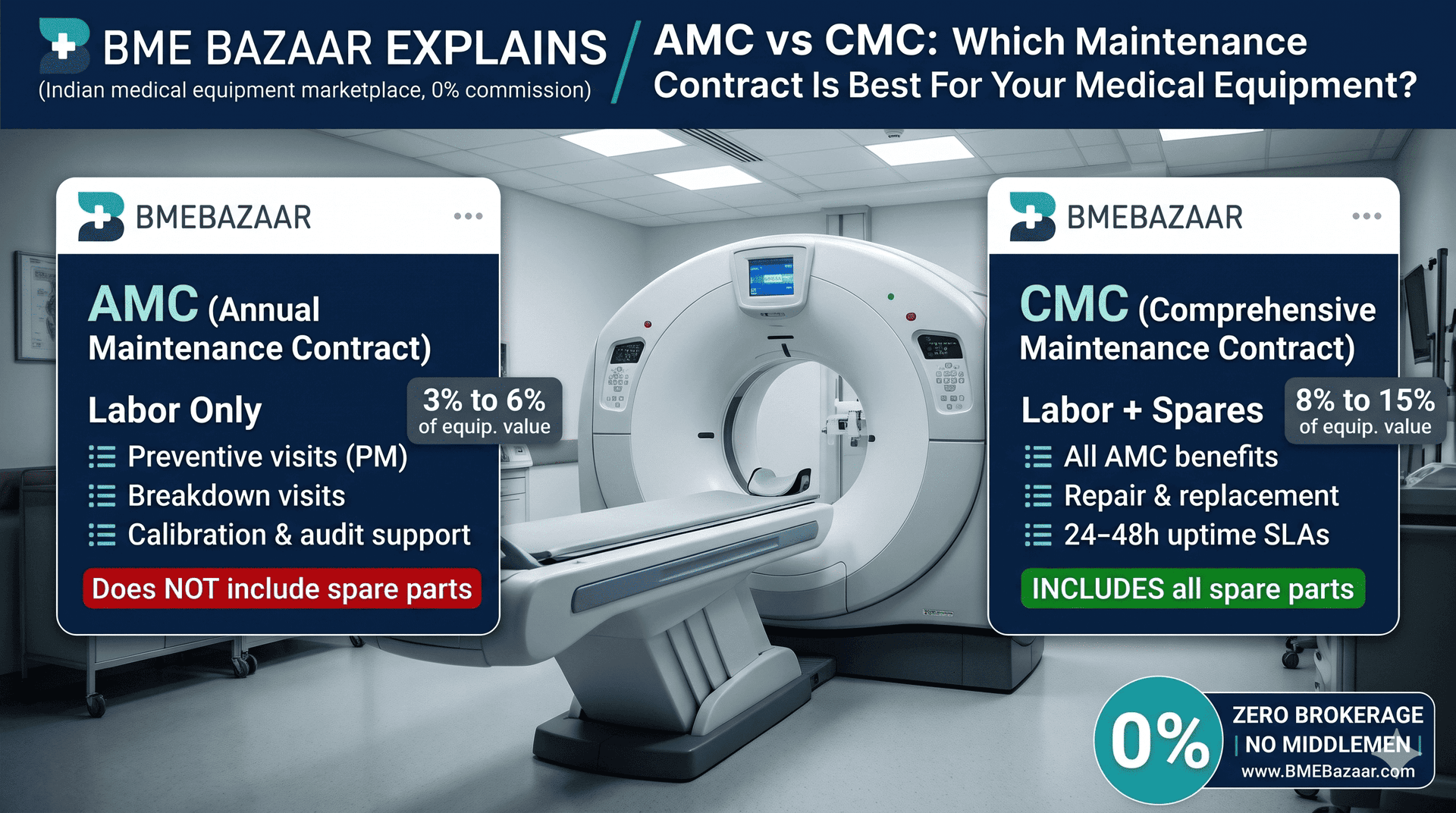
What It Covers | Preventive maintenance (PM), routine calibration, safety checks, and service engineer labor for breakdown calls. | Everything in an AMC PLUS spare parts, component repairs, and replacements (subject to exclusions). |
Spare Parts Cost | Extra (billed separately at actuals/MRP whenever a part fails). | Included in the fixed annual fee (except consumables/accessories). |
Upfront Annual Cost | Lower (~3% to 6% of equipment value per year). | Higher (~8% to 15% of equipment value per year). |
Financial Risk | High variability—one major part failure spikes your annual spend. | Predictable, capped annual maintenance budget. |
Best Suited For | Low-complexity, rugged devices (autoclaves, centrifuges, hospital beds, basic ECGs, suction units). | High-value, critical-uptime imaging & ICU gear (CT, MRI, Ultrasound, C-Arm, Ventilators, Analyzers). |
What is an AMC (Annual Maintenance Contract)?
An Annual Maintenance Contract (AMC) is a labor-only service agreement between a healthcare facility and an OEM (Original Equipment Manufacturer) or third-party biomedical service provider.
Under a standard AMC, the vendor commits to keeping your equipment calibrated, clean, and operational through scheduled visits and on-call troubleshooting—but you pay separately for any physical spare parts that need to be replaced.
What is Typically Included in an AMC?
Scheduled Preventive Maintenance (PM): Usually 2 to 4 planned visits per year to clean internal filters, lubricate mechanical assemblies, check electrical safety, and verify calibration.
Unlimited Breakdown Visits: Service engineer travel and labor charges when a machine malfunctions during the contract year.
Software Diagnostics & Calibration Logs: Essential documentation for NABH audits, NABL lab accreditation, and AERB radiation safety compliance.
What is NOT Included in an AMC?
Printed Circuit Boards (PCBs), power supply units, sensors, motors, valves, and displays.
High-value core components (e.g., CT X-ray tubes, ultrasound transducers, MRI cold heads, ventilator flow sensors).
Daily consumables and accessories.
Practical Reality Check: If a motherboard fails on a device under AMC, the service engineer will visit your hospital for free, diagnose the fault for free, and install the new board for free—but you will receive a separate invoice for the ₹85,000 replacement board plus GST.
What is a CMC (Comprehensive Maintenance Contract)?
A Comprehensive Maintenance Contract (CMC) is an all-inclusive protection plan that covers both service labor and spare parts for a fixed annual fee.
Think of a CMC as health insurance for your high-value medical machinery. If an internal electronic board burns out, a hydraulic pump fails, or a power supply dies mid-procedure, the service provider repairs or replaces the faulty component at zero additional cost to your facility.
What is Typically Included in a CMC?
All AMC Benefits: Scheduled preventive maintenance (PM), calibration, and unlimited emergency breakdown visits.
Complete Spare Parts Coverage: Replacement of failed electronic boards, internal cables, motors, power supplies, and mechanical assemblies.
Faster Uptime Commitments: Most CMCs include strict Service Level Agreements (SLAs)—such as a 24-to-48-hour response guarantee and an uptime guarantee (typically 95% to 98%), with penalty clauses or contract extensions if downtime exceeds agreed limits.
The Critical Catch: What Even a CMC Usually Excludes
Many first-time clinic and diagnostic center owners assume a CMC covers 100% of everything that could ever go wrong. It rarely does. Vendors routinely carve out high-wear items and fragile components in the fine print.
Before signing any CMC, check the Exclusion Clause for these four categories:
Consumables & Accessories: ECG cables, SpO2 finger probes, NIBP cuffs, ultrasound gel, thermal paper, printer cartridges, reagent tubing, and filters are almost always excluded.
Batteries & Light Sources: Lead-acid or lithium-ion backup batteries (in multipara monitors, infusion pumps, defibrillators, and portable X-rays) as well as OT light bulbs and endoscopy xenon lamps are usually treated as consumables.
Glassware & High-Wear Imaging Core Parts:
CT Scanners & X-Ray Systems: X-ray tubes and High-Voltage (HV) tanks are often excluded from standard CMCs unless you explicitly opt for a "Tube-Inclusive CMC" (which costs significantly more).
Ultrasound & Color Doppler: Ultrasound probes/transducers are frequently excluded from physical damage or crystal drop-out unless specifically added to the contract.
MRI Scanners: Liquid helium refills and RF coils may have separate caps or exclusions.
Physical, Liquid, or Power Damage: Damage caused by voltage fluctuations (operating without a servo stabilizer/online UPS), water spillage, rat/pest damage, or improper handling by untrained staff voids coverage.
Cost Comparison: AMC vs. CMC in the Indian Market
In India, service contract pricing is generally calculated as a percentage of the equipment’s current replacement value (or original purchase price, with a 5%–10% annual escalation as the machine ages):
AMC Pricing: Typically 3% to 6% of equipment cost per year (+ 18% GST).
CMC Pricing: Typically 8% to 15% of equipment cost per year (+ 18% GST).
Real-World Example: Color Doppler Ultrasound Machine (Worth ₹12,00,000)
Option A — AMC at 4%: You pay ₹48,000/year.
If nothing breaks: You save ₹72,000 compared to a CMC.
If the main beamformer PCB or power supply fails: A single board replacement can easily cost ₹1,20,000 to ₹1,80,000, pushing your total annual spend to ₹2,00,000+.
Option B — CMC at 10%: You pay ₹1,20,000/year.
If a major board fails: Your out-of-pocket repair bill is ₹0. Your annual budget remains completely predictable.
Which Contract Should You Choose? A Practical Decision Framework
Instead of applying a blanket rule across your entire hospital, match the contract type to the clinical criticality and spare-part cost of each device:
Choose a CMC When:
Downtime Directly Halts Revenue: If your sole CT scanner, C-Arm, Color Doppler, or fully automated biochemistry analyzer goes down for a week, lost patient footfall will exceed the entire annual CMC fee.
Spare Parts Are Proprietary & Expensive: Modern imaging systems, ICU ventilators, anesthesia workstations, and endoscopes use proprietary boards that cannot be repaired locally and cost lakhs to import.
You Are Buying Used or Refurbished Equipment: For pre-owned capital equipment (like a refurbished 16/64-slice CT or cath lab), securing a 1-year warranty followed by a comprehensive CMC protects you against age-related component fatigue.
Choose an AMC When:
The Device Has Minimal Electronics: Autoclaves, surgical tables, hydraulic/electric ICU beds, suction machines, hot air ovens, and examination lights rarely suffer catastrophic, high-cost electronic failures.
You Have Redundant Units: If your clinic has 6 multipara monitors or 10 syringe pumps, one unit going offline for a ₹6,000 sensor replacement won't shut down your ICU. An AMC across the fleet is far cheaper than paying 10–12% CMC on every unit.
Spares Are Readily Available Locally: Standard devices with generic power supplies and easily sourced parts rarely justify paying double or triple for a CMC.
Consider "In-House Biomedical + On-Call Service" When:
You run a mid-to-large hospital with an in-house biomedical engineering team handling routine PM, calibration checks, and minor repairs for low-risk ward equipment.
7 Pro Tips Before Signing an AMC or CMC in India
Lock in AMC/CMC Rates at the Time of Equipment Purchase: Never wait until the 1-year warranty expires to ask for CMC quotes. Vendors hold maximum leverage once your machine is installed. Negotiate Years 2–5 AMC/CMC rates (as a fixed % with capped escalation) before issuing the Purchase Order.
Demand an Uptime Guarantee Clause: Insist on a minimum 95% to 98% uptime commitment (calculated on working days) with a clear penalty—such as extending the contract free of charge by 2 days for every 1 day of delayed breakdown resolution.
Verify Spare Parts Availability (End-of-Support Check): Before buying any used or refurbished machine, confirm whether the OEM or third-party engineers still stock critical spares in India. A cheap CMC is useless if a replacement board takes 6 weeks to import.
Clarify "Turnaround Time" (TAT) by City Tier: In metros like Delhi, Mumbai, Bengaluru, Chennai, or Hyderabad, demand a 24-hour engineer response. In Tier-2 and Tier-3 towns, negotiate a realistic 48-hour SLA plus remote phone/video troubleshooting support.
Inspect Before Renewing an Expired Contract: If your equipment has been out of warranty/AMC for months, vendors will usually conduct a chargeable pre-contract health checkup and ask you to pay for any pre-existing faults before activating a CMC.
Check Power Conditioning Requirements: Keep documented service logs for your online UPS and servo voltage stabilizers. Without proof of clean power, vendors can reject CMC claims on burned power boards citing "external electrical surge."
Compare OEM vs. Verified Third-Party Service Engineers: While OEMs are ideal for high-end MRI/CT systems with proprietary software keys, specialized multi-vendor biomedical service providers often offer 30% to 40% lower CMC rates with faster local response for patient monitors, infusion pumps, ultrasound machines, and lab equipment.
Frequently Asked Questions (FAQs)
1. Does CMC cover X-ray tubes and ultrasound probes?
By default, most standard CMCs exclude X-ray tubes, HV tanks, and ultrasound transducers, or cover them only on a pro-rata basis. Always read the exclusions table carefully and ask for a separate rider if you want glassware or probe coverage.
2. Is GST applicable on AMC and CMC contracts in India?
Yes. Both AMC and CMC contracts are classified as maintenance and repair services and attract 18% GST in India. Make sure your vendor quote clearly specifies whether the quoted percentage is inclusive or exclusive of GST.
3. Can I get a CMC for used or refurbished medical equipment?
Yes. Reputable sellers and biomedical service providers across India offer AMCs and CMCs for refurbished imaging, ICU, and lab equipment—provided the machine passes an initial technical inspection and spares remain serviceable.
4. What is the difference between Warranty and CMC?
A warranty is provided free of cost by the manufacturer or seller for a set period (usually 12 months) immediately after purchase. A CMC is a paid annual renewal contract that extends similar parts-and-labor protection after the initial warranty period ends.
Upgrade Your Medical Equipment Smartly — With Zero Brokerage
Whether you are setting up a new diagnostic center, expanding an ICU, or replacing aging equipment whose CMC costs have become uneconomical, BMEBazaar connects you directly with verified hospitals, clinics, and medical equipment suppliers across India—with 0% brokerage and no middlemen.
Browse Verified New, Used & Refurbished Equipment: Compare transparent prices and technical specs directly from sellers across India on BMEBazaar.com.
Post Your Requirement: Looking for a specific CT, Ultrasound, C-Arm, Ventilator, or Lab Analyzer within a fixed budget? Submit your requirement directly and connect with verified sellers without paying dealer commissions.